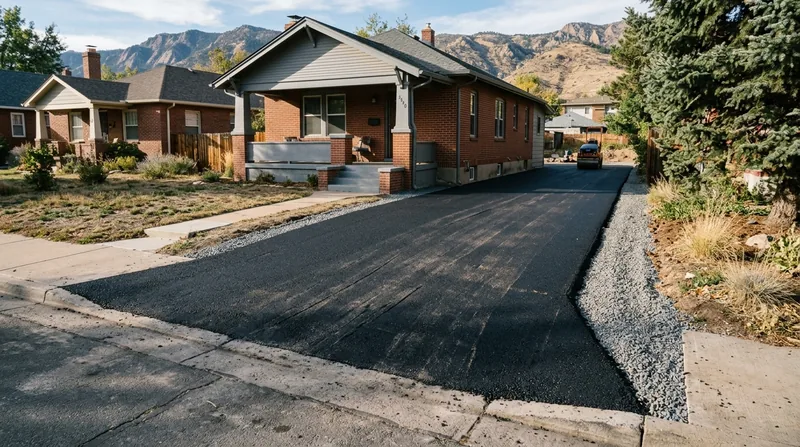




Denver's asphalt driveway paving and installation sits on ground that moves. The expansive clay beneath Capitol Hill, Park Hill, Lakewood, Arvada and the post-war ranch subdivisions of Jefferson and Arapahoe counties swells each spring when snowmelt soaks in, then shrinks back as the Front Range dries out through summer and fall. That cycle happens a hundred times a year in the freeze-thaw crossings alone, and it happens whether the thermometer says hot or cold. A mile of elevation loads our pavement with roughly a quarter more ultraviolet radiation than sea-level asphalt sees, so binder greys out and goes brittle years ahead of schedule. The single most common reason a Denver driveway heaves, cracks or drops at the apron is a base that was never deep enough to handle the clay movement underneath. We build a compacted aggregate base sized to Denver's frost line and UV load, then lay hot mix asphalt engineered for this specific climate. That is not a sales pitch. It is the only way a driveway stays flat here.
Why Asphalt Driveway Paving and Installation Matters in Denver's Freeze-Thaw Cycle
Denver's ground moves under every driveway. Spring snowmelt saturates the expansive clay, bentonite and montmorillonite weathered from volcanic ash that underlies the entire metro area, and the soil swells. By late summer, the Front Range is dry again and the ground shrinks back. That cycle stresses any surface laid on top, and it happens relentlessly. A driveway installed without a proper compacted aggregate base will crack, heave and fail in pieces because the clay underneath is moving, not because the asphalt is weak.
- We excavate to the frost line and install a compacted aggregate base deep enough to distribute the clay movement across a wider footprint.
- We lay hot mix asphalt in lifts sized for Denver's climate, not a generic specification from another region.
- We proof-roll the base to confirm compaction before any asphalt goes down.
- We specify tonnage and thickness on every estimate so you know exactly what you are paying for.
- We handle Colorado 811 utility locates before any excavation, because hitting a line is a federal crime and a homeowner liability.
Skipping the base work is the fastest way to turn a driveway into a cracked, heaving mess within three to five years. We do not skip it.
Key info: Denver's Paving Contractor class covers work in the city right-of-way, including the apron where your driveway meets the street. Permits are required in Denver and many surrounding cities. We help you navigate local permitting, but you verify with your municipality before we break ground. Check with the Denver Department of Transportation and Infrastructure or your city's building department.
For more on what happens when base work is done wrong, see our page on driveway replacement, which is often the only fix for a failed installation.
How We Install an Asphalt Driveway in Denver: The Process Step by Step
Installation is not just laying hot asphalt. The ground preparation, base compaction and material specification are where the durability lives. We start with a site visit to measure, assess drainage and understand what the clay is doing. Then we build the driveway to stay flat under Denver's climate for the life you expect from it.
- We call Colorado 811 to locate utilities and mark them on the ground.
- We excavate the driveway area to the frost line, typically 24 to 36 inches in the Denver metro area.
- We install and compact a crushed stone or recycled asphalt base in lifts, proof-rolling after each lift to confirm proper compaction.
- We establish proper drainage slope so water does not pond or undermine the base.
- We lay hot mix asphalt in two lifts, the base course and the wearing surface, both sized for Denver's climate and UV load.
- We compact the wearing surface to specification and allow it to cool and cure before traffic.
A typical residential driveway in Denver takes three to five days from excavation to final compaction, depending on size and weather. New asphalt should not be sealed for the first six to twelve months while the binder cures and hardens.
Example: A 3,000-square-foot driveway in Lakewood with a 24-inch base, 4 inches of compacted stone, and 2.5 inches of hot mix asphalt takes roughly four days to install. We measure the excavation, calculate tonnage, and specify it all on the estimate. You know what you are getting before we start.
If you are considering repair or resurfacing instead of a full installation, see our pages on driveway repair and asphalt resurfacing and overlay to understand when each approach makes sense.
Installation Methods and Material Choices
| Approach | Description | Best for |
|---|---|---|
| Full-depth asphalt installation | Excavation to frost line, compacted aggregate base, two-lift hot mix asphalt. Industry standard for Denver climate. | New driveways, complete replacements, areas where the base has failed or clay movement is severe. |
| Asphalt overlay (mill and overlay) | Milling off the top 1.5 to 2 inches of existing asphalt and laying a new wearing surface over the compacted base. | Existing driveways with sound bases but surface cracking, raveling or age. Saves cost and excavation time. |
| Recycled asphalt base with asphalt surface | Excavation, recycled asphalt millings compacted as base layer, new hot mix asphalt wearing surface on top. | Budget-conscious installations, environmental preference, areas where recycled material meets local code. |
| Tar and chip (chip seal) | Liquid asphalt sprayed over compacted base, aggregate chips spread and rolled in. Rustic appearance, lower initial cost. | Rural driveways, private roads, secondary access, budget applications. Not recommended in high-traffic urban areas. |
Asphalt Driveway Paving and Installation Cost in Denver: What to Expect
Asphalt driveway paving in Denver starts at around $6 per square foot for a straightforward installation with proper base work and two-lift asphalt. That baseline assumes a standard residential lot with accessible excavation, no major drainage complications and no utility conflicts. The actual cost per square foot moves up or down based on several concrete factors.
The depth of excavation is the first cost driver. Denver's frost line sits at roughly 36 inches, and you cannot cut corners there without risking heave and failure within three to five years. A driveway that requires 30 inches of compacted stone base costs more than one that needs 18 inches because you are moving more material. If the site has poor drainage or soft clay, the base gets deeper and the cost rises.
Access matters. A driveway on a wide-open lot in Westminster or Centennial is cheaper to install than one on a narrow lot in Capitol Hill or Park Hill where equipment has limited room to maneuver. Proximity to structures, existing utilities, trees and the street also affects equipment placement and the speed of the work.
Size works in your favor. A 2,000-square-foot driveway in Lakewood costs less per square foot than a 500-square-foot driveway because the equipment and crew are already on site. Larger jobs amortize the setup cost across more material.
Permit and utility locate costs are separate from the paving cost itself. Colorado 811 locates are required by law and are free, but if your city requires a permit for the apron or curb cut, that is a city fee you pay directly. We help you navigate the local permitting process, but the permit cost does not come through us.
The honest way to know your actual cost is to get a written estimate on site, with tonnage and thickness specified. We provide free estimates within 24 hours. Call (720) 674-7204 or visit our pricing page for more detail on what moves the cost up and down.
What to Look for When Hiring an Asphalt Paving Contractor Near Denver
The paving trade has a long history of itinerant crews who show up unsolicited with a pitch about leftover asphalt from a nearby job, demand a large cash deposit, and disappear before the asphalt cures. That is the fraud you hear about. The way you avoid it is by verifying the contractor before you sign anything.
Check that the contractor is fully insured and can provide a certificate of insurance on request. Ask for references from recent work in your area, and call them. A local contractor with a Denver address and Colorado plates is a stronger signal than an out-of-state crew. The single most credible thing a contractor can do is be verifiably local and willing to stand behind the work.
Get a written estimate that includes excavation depth, base material type and tonnage, asphalt thickness, and the total square footage. If the estimate has no tonnage or thickness on it, that is a red flag. You should know exactly what you are paying for.
Understand your local permitting requirements before you hire. Denver requires permits for apron work and curb cuts. Lakewood, Arvada, Westminster and other cities have their own rules. If you live in a master-planned community or HOA, check the architectural standards for approved driveway materials and any size restrictions. We help you navigate this, but the responsibility to verify is yours. Call your city building department or HOA before we start.
Ask the contractor about the base work and why it matters. If they minimize the base or suggest you can skip it to save money, that is a warning. Denver's clay movement is real, and the base is where the durability lives. A contractor who explains the base work and specifies it on the estimate is thinking long-term about your driveway.
For a free estimate and to discuss your specific site, contact us here or call (720) 674-7204. We measure on site, walk you through the process and answer questions before you commit to anything.
Asphalt Driveway Paving & Installation in Denver: Pricing Guide
| Service | Price | Details |
|---|---|---|
| Standard asphalt driveway installation | Starting at $6/sq ft | Full-depth excavation, compacted aggregate base, two-lift hot mix asphalt. Includes Colorado 811 utility locate. |
| Asphalt overlay (mill and overlay) | Starting at $3.50/sq ft | Milling existing surface, compacting base, new wearing course. Requires existing base to be sound and not heaved. |
| Recycled asphalt base with asphalt surface | Starting at $5/sq ft | Full excavation, recycled millings compacted as base, new asphalt wearing surface. Material cost lower than virgin stone. |
| Tar and chip driveway | Starting at $2.50/sq ft | Liquid asphalt and aggregate chips. Lower cost, rustic finish, best for rural and low-traffic driveways. |
| Permit and utility locate | Varies by city | Colorado 811 locate is free and required by law. City permit fees paid directly to municipality, not through us. |
| Free on-site estimate | No obligation | Written estimate with tonnage and thickness specified. Response within 24 hours at (720) 674-7204. |
Indicative pricing, the exact cost depends on square footage, finish, and site access. Free personalized estimate within 24h at (720) 674-7204.


