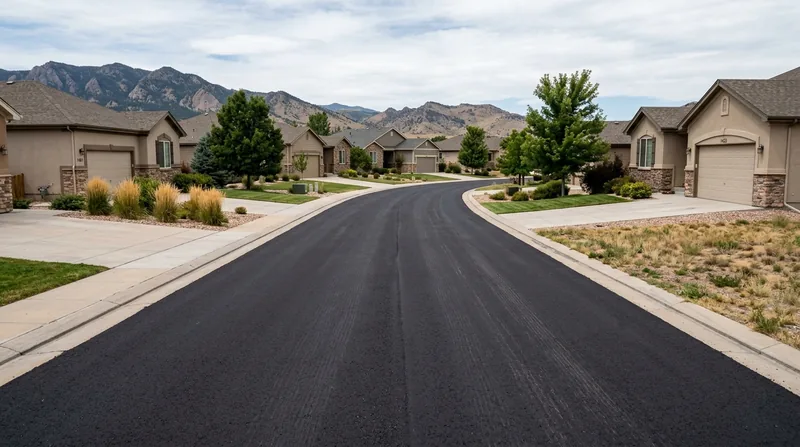




Private Road & HOA Paving in Denver means navigating shared surfaces across subdivisions where the ground itself is the real opponent. Denver's expansive clay and bentonite soils swell with spring snowmelt and shrink back as the Front Range dries, moving the base under any shared road year after year. Add a hundred freeze-thaw cycles annually and ultraviolet intensity that runs roughly 25 percent stronger than sea-level asphalt sees, and a private road that was paved in the 1990s or early 2000s is aging out now across Douglas and Weld county subdivisions. We design a base and binder course for shared traffic loads, work within HOA architectural standards and city right-of-way rules, and set the schedule around the weather windows that actually work in Colorado. The result is a road that holds under the clay and the freeze, not one that fails in the first thaw.
Why Private Road and HOA Paving Matters in Denver's Master-Planned Communities
Subdivisions across Highlands Ranch, Castle Rock, Centennial, and the newer developments in Weld County all share the same problem: a private road or HOA lane that was built to a minimum standard twenty or thirty years ago now carries the same clay heave and UV degradation that kills a residential driveway. The difference is scale and shared liability. A failed residential driveway costs one household to repair. A failed private road costs the HOA and every property owner on it. Patching buys time on a road with isolated failures, but once alligator cracking dominates the surface or the base has settled unevenly, the money belongs in resurfacing or full replacement, not in spot work that throws dollars away.
- Shared roads require a thicker base and binder course than a single-family driveway to handle multiple daily passes and seasonal freeze-thaw stress.
- HOA architectural standards often govern the appearance and material of private roads, and those rules must be verified before any bid is finalized.
- Denver and other municipalities regulate curb cuts, culverts, stormwater runoff, and right-of-way access where a private road meets the public street.
- Colorado 811 utility locates are required by law before any grading, base prep, or full-depth work begins, and scheduling that call is non-negotiable.
- Resurfacing an aging road is often the smarter choice than replacement if the base is sound, and a site visit with tonnage specs shows the HOA exactly what they are paying for.
A private road that is failing unevenly or showing base settlement needs an engineer's eye and a realistic timeline, not a bottom-line bid from a crew that did not measure the site.
Key info: Denver requires permits for driveway aprons and curb cuts where a private road meets the public street. Verify your HOA architectural standards and your city's stormwater rules before any excavation. We help navigate those requirements, but the HOA board and the local building department always have the final say on what is permitted.
For detailed guidance on permitting and regulations across Denver and surrounding jurisdictions, see the Denver building permit office website or contact your HOA directly.
How We Design and Build Private Roads for Denver's Soil and Climate
A private road in Denver starts with the ground, not with asphalt. We measure the site, assess the existing base, check for drainage and clay settlement patterns, and design a base thickness and material spec that holds under the seasonal movement this climate delivers. The binder course goes over a compacted aggregate base deep enough to bridge the clay heave that happens every spring. New asphalt is never sealed for the first six to twelve months while it cures and bonds properly to the base. We provide written estimates with tonnage specifications and a realistic timeline so the HOA board knows exactly what the road will cost and how long the work will take.
- Schedule a site visit where we measure the road, evaluate the existing base, and assess drainage and settlement patterns.
- Design a base and binder course spec that accounts for Denver's clay soils, freeze-thaw cycles, and shared traffic loads.
- Verify HOA architectural standards and coordinate with your city on permits, culverts, and right-of-way requirements.
- Call Colorado 811 for utility locates before any excavation or grading begins.
- Prepare and compact the base, lay the binder course, then finish with the top course asphalt.
- Allow the road to cure for six to twelve months before applying any sealcoat or additional surface treatment.
The timeline depends on road length, base condition, and weather windows. Most private roads in the Denver area are completed within two to four weeks once the base work begins.
Example: A half-mile private road in Highlands Ranch with a failing 1998 asphalt surface and an intact base gets resurfaced with 2.5 inches of new hot mix asphalt over a compacted recycled asphalt base. The HOA board approves the work in August, grading and base prep happen in September, paving happens in early October before the hard freeze, and the road is ready for winter traffic by late October. The cost runs higher than a simple overlay because the base is being rejuvenated, but it is far less than a full-depth replacement.
Private Road Paving Methods: Overlay, Resurfacing, and Full-Depth Replacement
| Approach | Description | Best for |
|---|---|---|
| Asphalt Overlay | New asphalt layer (1.5 to 2.5 inches) laid over the existing surface without removing the old pavement. | Roads with a sound base and surface cracks or minor rutting; quick, cost-effective solution when the foundation is solid. |
| Asphalt Resurfacing | Old surface is milled away, then new asphalt is laid over a compacted recycled base or aggregate layer. | Roads showing alligator cracking, base settlement, or drainage problems; removes the failed surface and rejuvenates the base. |
| Full-Depth Replacement | Complete removal of asphalt and base, new base installed to spec, new asphalt laid on top. | Roads with failed bases, severe clay heave, or where the original base was too shallow for Denver's soil and climate. |
| Recycled Asphalt Base | Milled asphalt from the old surface is compacted and reused as the base layer for a new asphalt surface. | Resurfacing jobs where the base is sound; cost-effective and reduces waste while maintaining structural integrity. |
The choice between overlay, resurfacing, and replacement depends on the condition of the base, the extent of surface failure, and how much weight the road carries. We assess that on site and recommend the approach that gives the HOA the best value over the next ten to fifteen years.
Private Road & HOA Paving Cost in Denver: What to Expect
The cost of private road paving in Denver depends on the length of the road, the condition of the existing base, the width and any drainage work required, and whether the road needs full-depth replacement or just resurfacing. A half-mile private road with a sound base and an aging surface typically runs from $15,000 to $35,000 for resurfacing with new asphalt. A full-depth replacement of the same road runs higher because the base is being removed and rebuilt to account for Denver's clay soils and freeze-thaw cycles. Longer roads, roads with poor drainage, and roads that require culvert work or right-of-way permitting all move the cost up.
The most important part of the estimate is the tonnage specification and the base design. That shows the HOA exactly what material is going into the road and why. We provide written estimates with full tonnage specs and a timeline so the board can make an informed decision. We also recommend getting two or three estimates from local contractors so the HOA can compare the scope and the cost. The lowest bid is not always the best value if the base spec is thin or the timeline is unrealistic.
For a detailed pricing breakdown and to schedule a free site visit, see our full pricing page or call us at (720) 674-7204. We respond within 24 hours with no obligation to book.
Private Road & HOA Paving Near Me: What to Look for When Hiring a Contractor in Denver
Hiring a paving contractor for a private road is different from hiring one for a residential driveway because the liability and the budget are shared across the entire HOA. Verify that any contractor you consider is fully insured and carries the coverage your HOA requires. Ask for written estimates with tonnage specs and base design details, not just a price per square foot. Check references from other HOAs or subdivisions the contractor has paved, and ask those references specifically about the timeline, the quality of the base prep, and how the road has held up over the past few years.
- Confirm that the contractor carries full insurance and is willing to provide a certificate of insurance to the HOA board.
- Ask for at least two or three written estimates with tonnage specs, base design, and a realistic timeline.
- Request references from other HOAs or private roads the contractor has paved, and call them directly to ask about durability and service.
- Verify that the contractor understands Denver's permit requirements and your city's stormwater and right-of-way rules.
- Confirm that the contractor will call Colorado 811 for utility locates before any excavation or grading begins.
- Ask whether the contractor has experience with Denver's clay soils and the base depth required to handle freeze-thaw cycles.
- Avoid contractors who offer unsolicited door-to-door bids, demand large cash deposits, or quote a price without a site visit and measurement.
A local contractor with a local address and local plates is your strongest protection against the itinerant paving scams that still target HOAs. The contractor should be willing to stand behind the work with a warranty on workmanship and be transparent about what the base will cost and why it matters in Denver's climate.
Ready to get a free estimate and talk through your road's condition? Contact us online or call (720) 674-7204. We measure the site, design a base and surface spec, and provide a written estimate with tonnage and timeline so the HOA board has all the information needed to make a decision.
Private Road & HOA Paving in Denver: Pricing Guide
| Service | Price | Details |
|---|---|---|
| Asphalt Overlay | Starting at $8,000 | New asphalt layer over existing surface for roads with sound base, minimal site visit required to assess condition |
| Asphalt Resurfacing | Starting at $15,000 | Milling and new asphalt for roads with moderate cracking or base settlement, includes recycled base rejuvenation |
| Full-Depth Replacement | Starting at $25,000 | Complete base removal and rebuild for failed roads or inadequate original base depth, Denver clay soils require deeper base |
| Site Visit & Estimate | Free | Measurement, base assessment, drainage evaluation, and written estimate with tonnage specs within 24 hours |
| Travel | Included | Denver and surrounding areas at no additional charge, no separate mileage fee or call-out cost |
Indicative pricing, the exact cost depends on square footage, finish, and site access. Free personalized estimate within 24h at (720) 674-7204.


