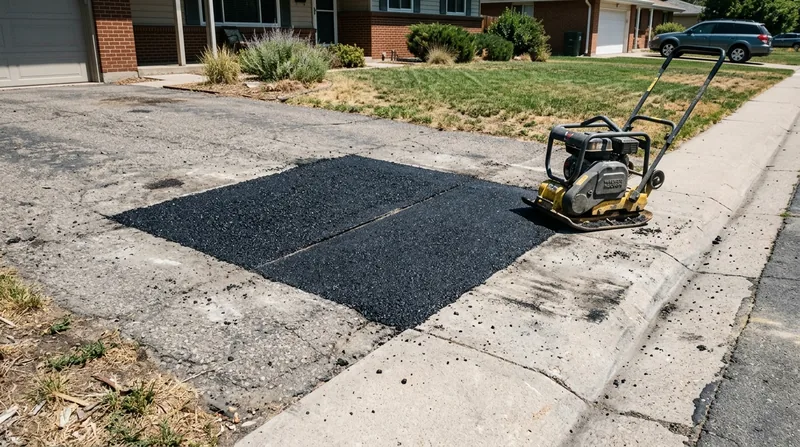




Denver driveways crack and heave where expansive clay shifts under the slab each season. The ground beneath Capitol Hill bungalows, Park Hill Victorians, and post-war ranch homes in Lakewood and Arvada swells with spring snowmelt and shrinks back as the Front Range dries out, pushing and pulling at asphalt that was never designed for a mile of elevation and a hundred freeze-thaw cycles a year. When cracks widen into chunks, when the surface heaves at the apron, or when a pothole opens in the wheel track, patching is the fastest answer. We cut out the failed section, repack the base so it holds, and match new hot mix into the old driveway so the repair bonds and lasts through the next winter. Driveway repair in Denver is not a cosmetic touch; it is structural work that stops water from getting under the slab and saves the base from collapse.
Why Driveway Repair Matters in Denver: Clay, Frost, and the Apron
Denver sits on bentonite and montmorillonite clay weathered from volcanic ash, a soil that expands when wet and contracts when dry. A driveway poured over inadequate base preparation fails faster here than anywhere else in the region. The problem is not just the freeze-thaw cycle, though we see more than a hundred of those a year; it is the ground movement that happens independent of temperature. Spring snowmelt pushes moisture into the clay, heaving the slab upward. Summer drought pulls it back down, leaving gaps at the edges and weak spots in the middle. After a few cycles, cracks turn into chunks, and chunks turn into potholes. The apron where the driveway meets the street is especially vulnerable because it takes the weight of two lanes of traffic plus the stress of the slope.
- We assess whether a crack is structural (needs repair now) or cosmetic (can wait) by measuring width, depth, and how much of the surface it covers.
- We cut out failed sections with clean edges so new asphalt bonds to the old, not just sits on top of it.
- We recompact the base with a plate vibrator to match the density of the surrounding subgrade, so the patch does not sink or heave.
- We match the new hot mix to the binder age of the old driveway so the color and texture blend and the patch holds through thermal stress.
Catching a crack early costs a few hundred dollars. Letting it run for two years costs a thousand. Ignoring it for five years until the base is gone means full-depth replacement. For guidance on what Denver requires for permits and apron work, check your local building department.
Key info: Denver's clay-based soil moves differently than the stable ground back east. A driveway that would hold for thirty years in Ohio fails in ten here. The difference is not the asphalt; it is the base. We always verify base depth and density before quoting a repair, because a patch over a thin base will fail again in two years.
How We Repair Driveways in Denver: From Inspection to Cure
A driveway repair begins with a site walk and a measurement. We look at the crack pattern, the age of the asphalt, the base condition, and the slope toward the street. If the damage is isolated to one or two sections and the rest of the driveway is sound, repair is the right call. If more than thirty to forty percent of the surface shows alligator cracking or potholes, the base is compromised and an overlay or full resurfacing will hold longer than patching. We pull a Colorado 811 utility locate before any excavation, cut the failed section out with a straight edge, haul the debris, regrade and recompact the base, and lay new hot mix at the same thickness as the surrounding driveway.
- We pull Colorado 811 locates to mark gas, electric, water and sewer before we dig, as required by law.
- We cut out the damaged section with clean vertical edges using a walk-behind saw or hand tools, depending on the size and location.
- We remove the cut-out material and haul it away, leaving a clean base that we inspect for moisture, settling, or further deterioration.
- We regrade the base if it has settled or eroded, using a gravel base that matches the surrounding soil and compacting it to ninety-five percent density.
- We lay hot mix asphalt at the same thickness as the existing driveway, typically three inches for a residential drive, and trowel the edges to bond to the old surface.
- We compact the new patch with a plate vibrator, working from the center outward to avoid pushing the edges out of alignment.
The new asphalt must cure for at least forty-eight hours before it sees heavy traffic, and up to two weeks in cool or wet weather. We always tell homeowners not to seal the new patch for six to twelve months while the binder fully hardens.
Example: A Capitol Hill homeowner in Denver called after a pothole opened in the wheel track of her narrow driveway. The crack had been there for two years. We cut out a six-foot section, found the base had settled two inches below the surrounding grade, recompacted new gravel, and laid three inches of hot mix. The patch held through the next two winters because we went below the visible failure to fix the root cause.
Driveway Repair Methods: Patching vs. Overlay vs. Replacement
| Approach | Description | Best For |
|---|---|---|
| Full-Depth Patching | Cut out the failed section down to the subgrade, recompact the base, and lay new hot mix. | One or two isolated cracks or potholes; less than ten percent of the surface damaged. |
| Skin Patching | Mill out the top layer of asphalt and lay new hot mix without touching the base. Works only if the base is solid. | Shallow cracks or weathered surface; base is proven to be sound and well-compacted. |
| Asphalt Overlay | Mill the existing surface and lay two to three inches of new hot mix over the existing base. | Widespread cracking (ten to thirty percent of surface) but base is still stable; cost-effective alternative to replacement. |
| Full-Depth Replacement | Remove all existing asphalt and base, regrade to proper slope, compact new base, and lay new asphalt from scratch. | More than thirty to forty percent of surface failed; base is compromised; heaving or settlement is severe. |
The choice between these methods depends on how much of the driveway has failed and how deep the damage goes. A single pothole in an otherwise sound driveway is a patch. Alligator cracking across half the surface means the base is failing and an overlay will not hold for more than a few years. We always explain the trade-off between cost now and durability later, and we recommend repair or overlay before replacement whenever the driveway justifies it.
Driveway Repair Cost in Denver: What to Expect
A straightforward pothole or localized crack repair in Denver starts at $450 to $650 for a patch up to about fifty square feet. The price moves up with the size of the section, the depth of the damage, how much base work is required, and how far the site is from our shop. A driveway that has settled or heaved may need grading and base recompaction, which adds time and material. If the damage covers more than thirty to forty percent of the surface, patching becomes uneconomical and an overlay or full resurfacing is the better investment. We provide written estimates with tonnage and thickness specifications, and we include a site visit and measurement at no charge.
The best way to lock in an accurate price is to call us for a free estimate. We walk the driveway, measure the damage, assess the base, and give you a number with no obligation. Response time is within twenty-four hours at (720) 674-7204. For a full pricing overview and service area details, visit our pricing page.
What to Look for When Hiring a Driveway Repair Contractor Near Denver
The single strongest trust signal in driveway paving is being verifiably local. The historic scam in this trade is the itinerant door-to-door crew with out-of-state plates who offer to use "leftover asphalt from a job nearby" and ask for a large cash deposit upfront with no written contract. A legitimate contractor gives you a written estimate with tonnage and thickness, maintains insurance, and operates from a local address with local phone number. Ask any contractor for references from recent jobs in your neighborhood, and call at least two. If you are in a master-planned community or an HOA, verify the architectural standards for driveway material and any apron extensions before we start work. If your driveway apron extends into the street right-of-way, your city may require a permit; we help you navigate local permitting, but the responsibility to verify belongs to you. Denver has its own building department and permitting rules, and those rules vary from Lakewood to Westminster to Thornton. Call your municipality before we begin, or ask us to help you find the right office.
- We are fully insured and carry a certificate of insurance available on request.
- We provide written estimates with thickness, tonnage, and material specs before we start work.
- We pull Colorado 811 utility locates before any excavation, as required by law.
- We operate from a local Denver address and respond to estimates within twenty-four hours.
- We explain the difference between repair, overlay, and replacement so you understand what you are paying for and why.
- We do not ask for a large cash deposit upfront, and we do not pressure you to decide on the spot.
For a free estimate and to discuss your specific driveway, contact us online or call (720) 674-7204. We have been in business since 2012 and serve Denver, Aurora, Lakewood, Thornton, Arvada, Centennial, Littleton, and surrounding areas.
Driveway Repair in Denver: Pricing Guide
| Service | Price | Details |
|---|---|---|
| Pothole or localized crack repair | Starting at $450 | Patch up to fifty square feet with full-depth cutting and base recompaction included in estimate |
| Medium patch (fifty to one hundred fifty square feet) | Starting at $800 | Larger section repair; cost varies with base condition, depth of damage, and access to the site |
| Extensive patching or partial resurfacing | On estimate | When damage covers ten to forty percent of surface, overlay or resurfacing is more cost-effective than multiple patches |
| Travel | Included | No separate mileage or call-out fee within Denver and surrounding metro areas |
| Free estimate | No charge | Response within twenty-four hours; written quote with tonnage and thickness specifications included |
Indicative pricing, the exact cost depends on square footage, finish, and site access. Free personalized estimate within 24h at (720) 674-7204.


