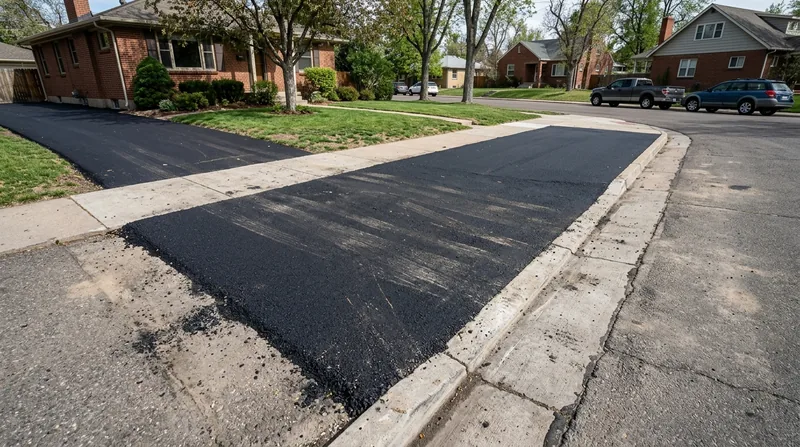




Denver's older neighborhoods, from Capitol Hill to Park Hill to the squares and bungalows lining Washington Park, sit on driveways poured decades ago with minimal setback from the sidewalk. The post-war ranch ring through Lakewood, Arvada, and Aurora has original driveways from the 1990s and 2000s now aging out together. Underneath lies expansive clay and bentonite that swells with spring snowmelt and shrinks as the Front Range dries, so the ground moves under any slab regardless of temperature. Add more than a hundred freeze-thaw cycles a year, a mile of elevation that loads the surface with roughly a quarter more ultraviolet than sea-level pavement sees, and driveway extensions, widening and aprons become critical infrastructure where the slab meets the street. Denver cares most about that joint, so we widen or extend the slab, tie the new pitch to the old, and match the apron so it drains at the city's required grade. The difference between a driveway that functions for twenty years and one that fails in five often comes down to how that transition is built.
Why Driveway Extensions and Aprons Matter in Denver's Climate
The apron where your driveway meets the street is not just cosmetic. It handles the load transfer between your slab and the city's pavement, and it has to shed water fast enough that it does not pool and refreeze on winter mornings. In Denver, that joint is where ice forms first, where frost heave starts, and where the ground movement from clay expansion is most visible. A poorly pitched or undersized apron lets water run back under the driveway, and in a climate that sees a hundred freeze-thaw cycles a year, that water becomes the enemy of whatever is underneath.
- An undersized apron forces water to back up under the driveway and settle in the base.
- Improper pitch means meltwater pools instead of running toward the street and storm drains.
- A disconnected or cracked apron lets freeze-thaw cycles work into the joint, lifting and separating the slab.
- A narrower driveway than the garage opening or parking area forces vehicles to track onto soft shoulders and the lawn.
- Widening the slab also widens the apron, so the transition is proportional and stable.
Getting the apron right the first time costs less than repairing a heaving driveway or replacing the entire base in five years.
Key info: Denver's driveway aprons are regulated by the city's right-of-way rules and stormwater code. Curb cuts, apron width, and drainage pitch are set by the municipal code, and permits are required before work begins. We help you navigate those rules with the City of Denver or your local municipality. Check with your building department or call (720) 674-7204 to confirm what your neighborhood requires.
For detailed permitting requirements in your area, see the City of Denver Permits & Licenses page.
How We Build Driveway Extensions, Widening and Aprons in Denver
A driveway extension or widening is not a simple pour. We start with a site visit to measure the existing slab, check the pitch, inspect the base, and confirm the city's setback and apron requirements for your address. We then set the grade so the new section ties into the old without a lip or a drop, and we prepare the base so the new asphalt sits on the same compacted aggregate that supports the rest of the drive. The apron gets extra attention: we pitch it to the street at the city's required slope, tie it to the curb cut or lip, and finish it smooth so water runs off and vehicles can move onto the street without catching an edge.
- We measure the existing driveway, apron, and setback, and verify the city's requirements for your zone.
- We excavate and prepare the base, removing soft soil and laying compacted aggregate to the depth your site requires.
- We set forms so the new slab ties into the old without a step or a gap.
- We pave the extension or widening with hot mix asphalt, matching the thickness and binder of the existing driveway.
- We finish the apron with proper pitch toward the street and smooth troweling so it drains and looks finished.
- We proof roll the base and inspect the compaction before laying asphalt.
The entire process takes one to three days depending on the size of the extension and the base prep required.
Local example: A narrow driveway in Lakewood serving a 1960s ranch with a single-car garage often needs widening to accommodate two vehicles or modern SUV overhangs. We extend the slab to match the garage opening or the parking area, then build an apron that ties to the existing curb cut and pitches at the city's required slope. The new section sits on a compacted base deep enough to handle the clay movement underneath, so the joint stays stable through the spring thaw and the dry season that follows.
See our full Asphalt Driveway Paving & Installation page for details on base preparation and new-driveway construction.
Methods and Approaches for Driveway Extensions and Widening
| Approach | Description | Best for |
|---|---|---|
| Extension with new apron | Excavate, prepare base, pour extension, finish apron with proper pitch to street | Adding length to the driveway or widening to match garage opening or parking area |
| Full-width widening | Extend the driveway on one or both sides, match existing thickness, tie to old slab | Narrow driveways that need to accommodate wider vehicles or dual-vehicle parking |
| Apron repair and re-pitch | Remove and replace only the apron section, reset pitch, tie to existing driveway | Existing apron that pools water or has cracked and separated from the main slab |
| Turnaround and widening | Extend driveway to create a three-point turn or parking area, build apron at street edge | Long driveways or narrow lots where vehicles need room to turn without backing onto street |
Driveway Extensions, Widening and Aprons Cost in Denver: What to Expect
A driveway extension or widening in Denver starts at around $1,800 to $2,500 for a modest extension of 200 to 300 square feet with standard base prep and a new apron. A full-width widening of an existing driveway or a larger extension can run $3,500 to $6,000 or more, depending on the square footage, the depth of base preparation required, and whether the existing apron needs to be removed and rebuilt. The single biggest factor is the condition of the ground underneath: clay that is soft or has heaved requires deeper base prep and more compacted aggregate, which adds cost and time. Access also matters: if the site is tight or requires equipment to be brought in from an alley or side yard, that adds labor and logistics.
The best way to know what your job will cost is to get a written estimate on site. We measure the driveway, check the base, confirm the city's requirements, and give you a tonnage spec and a line-by-line breakdown of labor, materials, and base prep. We also explain whether your existing apron can be salvaged or needs to be removed and rebuilt, because that choice is often where the cost moves. Get two or three estimates so you can compare not just the price, but what is included at each price point.
For a full pricing overview and to understand what factors move the cost up or down, see our Pricing page. Call (720) 674-7204 for a free estimate, no obligation.
What to Look for When Hiring a Driveway Paving Contractor Near Denver
A driveway extension or widening is a construction job that involves excavation, base prep, and asphalt paving, so permitting and contractor selection both matter. In Denver, the city requires a permit for apron work and curb cuts, and licensing and contractor standards are set by the City and County of Denver. Before you hire, verify that any contractor you are considering is fully insured and can show you a certificate of insurance. Ask for references, especially from recent jobs in your neighborhood, so you can see how the work has held up over a season or two. Get a written estimate with tonnage and thickness specs so you know what you are paying for, not just a price per square foot. If your property is in an HOA, check the architectural standards before starting, because some master-planned communities have restrictions on driveway materials or widths. And always call Colorado 811 before any excavation, because utility locates are required by law and you do not want to hit a gas line or water main while digging the base.
- Ask to see proof of full insurance coverage and a current certificate of insurance.
- Request references from three recent projects, ideally in your neighborhood or a similar lot type.
- Get a written estimate that includes square footage, tonnage, thickness, base depth, and labor.
- Check your HOA covenants or architectural standards to confirm driveway materials and width are permitted.
- Call Colorado 811 before any excavation to mark utilities, and ensure the contractor calls before work begins.
- Verify that the contractor understands Denver's right-of-way and apron pitch requirements.
A contractor who can explain why the base matters, who gets the permit details right, and who does not push a price that sounds too good is the one who will build a driveway that lasts.
Ready to get started? Contact us for a free estimate, or call (720) 674-7204. We serve Denver, Aurora, Lakewood, Westminster, Thornton, Arvada, Centennial, Littleton, and surrounding areas.
Driveway Extensions, Widening and Aprons Near Me in Greater Denver
We have been paving driveways and managing apron work across Denver and the surrounding counties since 2012. We understand the clay, the freeze-thaw cycles, the municipal codes, and the specific lot constraints of each neighborhood. Whether you are in a tight Capitol Hill square lot, a wide Lakewood ranch, or a newer subdivision in Aurora or Centennial, we know what the ground and the city will require. Call us for a free estimate, no obligation.
Driveway Extensions, Widening & Aprons in Denver: Pricing Guide
| Service | Price | Details |
|---|---|---|
| Small extension or apron repair | Starting at $1,800 | 100 to 200 square feet, standard base prep, new apron with proper pitch to street |
| Moderate extension or full-width widening | Starting at $3,200 | 300 to 500 square feet, base excavation and compaction, apron tie-in to existing driveway |
| Large widening or turnaround | Starting at $5,500 | 600 to 1,000 square feet or larger, deeper base prep for clay movement, multi-section apron |
| Complex base prep or soft soil | On estimate | Site conditions that require deeper aggregate, removal of old apron, or challenging access need on-site measurement |
| Travel and estimate | Included and free | No separate call-out fee or mileage charge in Denver and surrounding areas, response within 24 hours |
Indicative pricing, the exact cost depends on square footage, finish, and site access. Free personalized estimate within 24h at (720) 674-7204.


