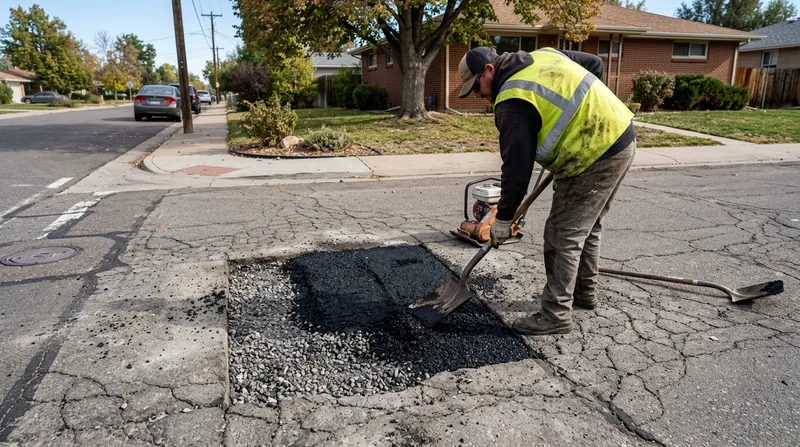




Denver's expansive clay and bentonite subgrade swells with spring snowmelt and shrinks as the Front Range dries out, pushing water into cracks and opening potholes fast once freeze-thaw cycles take hold. A hundred freeze-thaw crossings a year, combined with a mile of elevation that loads the pavement with roughly a quarter more ultraviolet than sea-level asphalt sees, means binder greys and goes brittle years ahead of schedule. Pothole Repair & Asphalt Patching in Denver stops the damage before it spreads: we cut back to solid material, tack the edges, and compact fresh hot mix flush so the patch holds through the next winter. Whether it is a single pothole in your Capitol Hill bungalow's driveway or a network of failed patches across a Westminster parking lot, the method is the same. Catch potholes early and a patch costs far less than resurfacing the whole surface later.
Why Potholes Form Fast in Denver and Why Patching Matters
Denver's climate and soil create the perfect storm for pothole growth. The clay-based subgrade underneath every driveway and parking lot in the metro area expands when it absorbs snowmelt in spring and contracts as summer heat dries it out. That movement cracks the asphalt above it, water seeps into those cracks, and the next freeze-thaw cycle pushes the pieces apart. Within weeks, a small crack becomes a pothole. Left unpatched, a single pothole spreads the damage sideways into the surrounding asphalt, and what started as a $500 repair becomes a $3,000 or $5,000 resurfacing job.
- Water trapped under the surface expands when frozen, pushing asphalt apart and widening the hole with each cycle.
- Vehicles striking the pothole's edge accelerate the breakup and can damage suspension and tires.
- A patched pothole that is not compacted properly or does not extend deep enough will pop loose the following winter.
- Patching stops the water infiltration and seals the base, preventing the pothole from growing into the surrounding pavement.
- Early patching is the cheapest way to extend the life of the entire driveway or lot.
Addressing potholes as soon as they appear is the single most cost-effective maintenance step a homeowner or property manager can take.
Key info: Denver's older neighborhoods around Washington Park and Capitol Hill sit on driveways poured decades ago with minimal setback from the sidewalk, and those narrow lots are prime territory for pothole damage because water has nowhere to drain. Post-war ranches in Lakewood and Arvada face the same problem, and newer subdivisions in Douglas and Weld counties are now aging into the same failure pattern all at once because of the shared clay subgrade.
For more on how to recognize when a repair is the right choice versus a full resurfacing, see our Driveway Repair page.
How We Patch Potholes: The Denver Method That Holds
A pothole patch that fails the next winter is not a patch, it is a waste of money. The difference between a patch that holds and one that pops loose is how deep we cut, how well we prep the base, and how thoroughly we compact the new asphalt. We do not fill potholes with cold patch or temporary material. We remove the failed asphalt and the loose base material underneath it, cut back to solid ground, tack the edges with a bonding agent, and compact fresh hot mix asphalt in multiple lifts so it bonds to the existing pavement and does not settle or pop loose.
- We measure the pothole and assess how far the damage has spread into the surrounding asphalt and base.
- We cut back to solid material, removing all loose or failed asphalt and base down to competent ground.
- We clean the edges and apply a tack coat to bond the new material to the old pavement.
- We place hot mix asphalt in compacted lifts, finishing it flush with the surrounding surface.
- We proof roll the patch under a vehicle to ensure it is fully compacted and will not settle.
The entire process takes a few hours for a single pothole or a small cluster, and the patch is ready for traffic immediately after rolling.
Real example: A Thornton homeowner called us about a pothole forming in the apron where the driveway meets the street. We cut it back 18 inches in all directions to ensure we removed all the failed base, tacked it, and placed three lifts of hot mix, finishing it flush. The patch has held for three years because we went deep enough to address the clay movement underneath. A cold-patch job would have failed by the following spring.
If you have multiple potholes across a large area of the driveway or parking lot, see our Asphalt Resurfacing & Overlay page to understand when patching throws money away and resurfacing makes sense.
| Approach | Description | Best For |
|---|---|---|
| Full-Depth Patch | We cut through the asphalt and into the base, remove all failed material, and replace it with compacted hot mix and base aggregate. | Potholes where the base is compromised or water has penetrated deeply; prevents regrowth. |
| Shallow Patch | We remove the failed asphalt layer only, tack the base, and place new hot mix at the same depth as the surrounding surface. | Small surface potholes where the base is still solid and the damage is confined to the top course. |
| Pothole Prevention | We identify cracks and areas where water is beginning to pool or infiltrate, and patch them before they become potholes. | Maintenance inspections in spring and fall to catch damage early before the freeze-thaw cycle opens it up. |
| Multiple Pothole Patching | We patch several potholes in one trip and can coordinate the work to minimize disruption to parking or access. | Parking lots or large driveways with multiple failed spots; more cost-effective than individual visits. |
Pothole Repair & Asphalt Patching Cost in Denver: What to Expect
Pothole patching in Denver starts at around $450 for a single pothole repair, but the actual cost depends on how deep the damage goes, how large the failed area is, and whether the base underneath is still solid or has been compromised by water infiltration. A shallow pothole in a residential driveway costs less than a full-depth patch in a parking lot where the base has failed. We always quote on site after measuring and assessing the damage, because the difference between a $500 patch and a $1,500 patch is whether we are replacing asphalt only or asphalt plus base material.
The biggest cost drivers are depth of cut, area of failure, and how far the damage has spread into the surrounding pavement. A pothole the size of a dinner plate costs less than one the size of a car tire. If the base is soft or wet, we may need to excavate deeper and replace more material. If multiple potholes are clustered together, we can patch them in one trip and reduce the per-pothole cost. Getting two or three estimates from local contractors is the smartest way to understand the scope and compare pricing fairly.
See our full pricing overview for more detail on cost factors and how we structure estimates.
Pothole Repair & Asphalt Patching Near Me: What Denver Homeowners Should Know Before Hiring
The single strongest way to verify a contractor's legitimacy is to confirm they are local, with a local address and local plates. The historic fraud in driveway paving is the itinerant door-to-door crew that shows up with an out-of-state truck, claims to have leftover asphalt from a nearby job, quotes a price that sounds too good, and asks for a large cash deposit upfront. Those crews are gone before the patch fails. A real paving contractor has a local shop, a phone number, references from neighbors you can call, and a written estimate that spells out the depth of cut, the tonnage of material, and the warranty on the work.
Before you hire anyone, ask for and check references from other Denver homeowners or property managers. Call at least two of them and ask whether the patch held and whether the contractor showed up when promised. Get a written estimate that includes the depth of the cut, the square footage or tonnage of material, and the timeline. Verify that the contractor is fully insured. If your driveway apron borders the street or a city right-of-way, ask the contractor whether a permit is required in your municipality, and confirm with your city or county before work begins. Many Denver neighborhoods have HOA rules about driveway repairs and materials, so check your architectural guidelines if you are in a master-planned community. Call us at (720) 674-7204 for a free estimate and we will walk you through the local permitting and approval process.
- Verify the contractor is fully insured and ask to see the certificate of insurance.
- Get a written estimate that names the depth of cut, the area of repair, and the tonnage of asphalt or base material.
- Check references from at least two previous customers in your area.
- Ask whether a permit is required for the work in your city or county, and confirm the contractor will help you navigate it.
- If you are in an HOA, check your architectural guidelines before approving any driveway work.
- Never pay a large cash deposit upfront. A reputable contractor will invoice after the work is complete.
A local contractor with a verifiable track record and a clear written estimate is the foundation of a repair that holds.
For a free estimate and a walk-through of the local permitting process for your specific driveway, contact us today.
Pothole Repair & Asphalt Patching in Denver: Pricing Guide
| Service | Price | Details |
|---|---|---|
| Single Pothole Repair | Starting at $450 | Shallow pothole in residential driveway, full-depth cut and compacted patch, ready for traffic same day |
| Full-Depth Pothole Patch | Starting at $650 | Pothole with compromised base, removal of failed asphalt and base, replacement with compacted hot mix and aggregate |
| Multiple Pothole Patching | Starting at $1,200 | Three to five potholes in one location, coordinated in single trip, cost per hole decreases with quantity |
| Parking Lot or Large Area Patching | On estimate | Multiple potholes across large surface area, base assessment required, written tonnage and depth specifications included |
| Free Estimate | No charge | On-site assessment, written quote within 24 hours, no obligation to book, call (720) 674-7204 |
Indicative pricing, the exact cost depends on square footage, finish, and site access. Free personalized estimate within 24h at (720) 674-7204.


