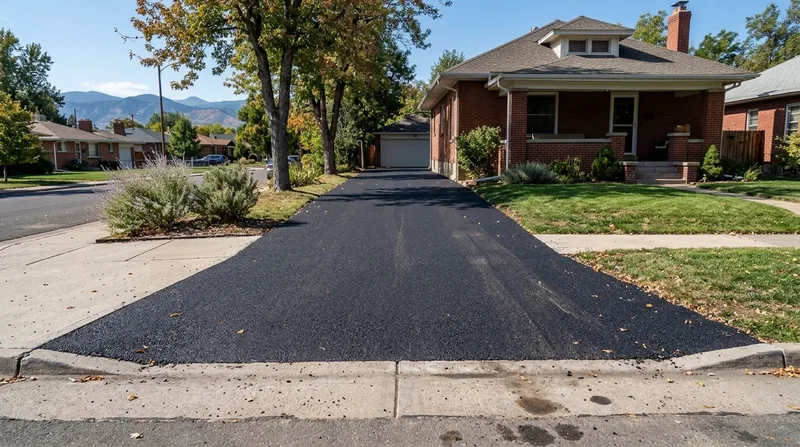




Driveway Replacement in Denver means removing a failed slab down to the subgrade, rebuilding the aggregate base to handle clay movement, and pouring fresh hot mix asphalt pitched away from the house. Denver's clay-heavy soil, freeze-thaw cycles that exceed a hundred per year, and ultraviolet load at mile-high elevation all conspire to shorten the life of any driveway poured without a real base underneath it. A slab that heaves, cracks in the alligator pattern, or drops at the apron has usually lost its base to clay expansion and frost action. Patching and resurfacing buy time on a structurally sound driveway, but once the base fails, only replacement restores the drive to its original pitch and longevity. We remove the old pavement, rebuild the foundation, and pour new asphalt that will handle Denver's climate for decades to come.
Why Driveway Replacement Matters in Denver's Challenging Climate
Denver sits on expansive clay weathered from volcanic ash that swells when it absorbs spring snowmelt and shrinks as the Front Range dries out. That ground movement happens whether the thermometer rises or falls. A driveway poured on a thin or absent base will heave, crack, and eventually fail because the clay underneath never stops moving. Add more than a hundred freeze-thaw crossings per year and ultraviolet degradation that runs roughly twenty-five percent higher than sea-level pavement sees, and the binder in asphalt goes brittle years ahead of schedule. The result is alligator cracking across the surface, potholes that grow faster than patches can fill them, and a slab that drops at the apron where it meets the street or garage. When those signs appear, the base is gone, and replacement is the only fix that restores the driveway to original pitch and load capacity.
Replacement is also the right call when:
- Extensive alligator cracking covers more than thirty to forty percent of the surface.
- The driveway heaves noticeably in spring or settles unevenly across its length.
- Patching and resurfacing have been done multiple times and cracks return within a season or two.
- The slab is more than twenty-five to thirty years old and shows signs of base failure.
- The apron has dropped more than half an inch relative to the garage floor or street.
When any of these conditions are present, replacement stops the cycle of repair and puts a new, properly built driveway in place.
Local example: A Capitol Hill bungalow built in the 1920s on a narrow lot had a driveway poured in the 1980s without an aggregate base. By 2020, freeze-thaw had lifted the slab three inches, and alligator cracking covered sixty percent of the surface. Patching had been done four times in five years. Full replacement with a four-inch compacted base and three-inch hot mix put the drive back to original grade and pitch.
For detailed guidance on what qualifies for replacement versus repair, see our driveway repair page or contact the Denver Department of Community Planning and Development at denvergov.org for questions about permits and apron standards in your neighborhood.
How We Handle Driveway Replacement from Start to Finish
Replacement begins with a site visit to measure the driveway, assess the base condition, check for utilities, and verify any local permit requirements. We provide a written estimate that specifies the square footage, the thickness of the base and asphalt, the tonnage of materials, and the timeline. Once you approve, we schedule the work and coordinate with Colorado 811 for a utility locate if excavation is needed, which it always is in full-depth replacement. We remove the old slab and haul it away, prepare and compact the subgrade, lay a four-inch compacted aggregate base to handle clay movement, and finish with three inches of hot mix asphalt pitched away from the house and any structures. The drive is ready for light traffic in a few hours and can take a full load within twenty-four to forty-eight hours depending on weather.
The process follows this sequence:
- We excavate and remove the old asphalt slab, hauling debris off-site.
- We inspect and prepare the subgrade, proof-rolling it to verify compaction.
- We lay and compact a four-inch aggregate base engineered for clay soils.
- We set grade stakes to ensure the new drive pitches away from the house and meets the street or garage at the correct elevation.
- We place hot mix asphalt in lifts, rolling each one to proper density and finish grade.
- We stripe and mark the drive if needed and remove all equipment and debris.
The entire job typically takes three to five days depending on the size of the driveway and weather conditions.
Littleton example: A ranch-style home built in 1995 had a 550-square-foot driveway that had settled and cracked. Replacement took four days: day one for excavation and base prep, day two for aggregate base, day three for asphalt placement, and day four for final grading and cleanup. The drive was usable the next morning and fully cured within a week.
For more on how base preparation and grading affect the longevity of your new driveway, visit our gravel driveway and grading page to understand the foundation work that underpins all our paving.
Driveway Replacement Methods and Approaches
| Approach | Description | Best For |
|---|---|---|
| Full-Depth Replacement | Remove old slab, excavate to subgrade, build compacted aggregate base, place new hot mix asphalt in multiple lifts. | Base failure, extensive cracking, heaving, or settlement. The standard solution for Denver clay soils. |
| Milling and Overlay | Mill the top one to two inches of old asphalt, inspect the base, and place new hot mix on top. Base must be sound. | Surface wear and cracking when the base is still intact. Faster and less expensive than full replacement, but only if the foundation is solid. |
| Resurfacing | Clean the existing surface, tack coat, and place a new layer of hot mix asphalt without removal or milling. | Minor surface wear, oxidation, or graying when the existing slab is structurally sound and properly pitched. |
| Recycled Asphalt Base with New Surface | Remove old slab, crush and recompact it as aggregate base, and place new hot mix on top. Reuses material on-site. | Budget-conscious replacement when the old asphalt is structurally sound enough to serve as base material and haul-away cost matters. |
Each approach is evaluated on-site based on the condition of the existing slab, the integrity of the base, local soil conditions, and your budget. Full-depth replacement is the most common choice in Denver because clay expansion and frost action typically compromise the base long before the top layer fails.
Driveway Replacement Cost in Denver: What to Expect
Driveway replacement in Denver typically starts at $7 per square foot for a straightforward full-depth job on a standard residential driveway with good access and no complications. A 500-square-foot driveway at that rate runs approximately $3,500 before any site-specific factors. The price moves up based on several real variables: the complexity of the base prep if the subgrade is unstable or poorly drained, the length of the driveway and whether it requires multiple passes with equipment, the need for apron work or curb cuts that require municipal permits, and the timing of the job if it falls during peak season when crews are fully booked.
Factors that affect the final cost include:
- Square footage of the driveway and any widening, extensions, or turnarounds included in the scope.
- Base condition and whether the subgrade requires proof-rolling, regrading, or drainage correction.
- Access for equipment and material delivery, especially in dense urban neighborhoods like Capitol Hill or Park Hill.
- Permit requirements and HOA architectural review, which add time and coordination.
- Seasonal demand and weather conditions that may extend the timeline or require additional prep work.
- Haul-away costs for old asphalt if it cannot be recycled on-site or used for another project.
The best way to understand the real cost for your driveway is to get written estimates from two or three contractors. Each estimate should specify the square footage, the thickness of the base and asphalt, the tonnage of materials, and the timeline. We provide a free estimate within twenty-four hours at (720) 674-7204, and you can compare our numbers and approach against other bids. See our full pricing page for more detail on what moves the needle and what is included at each price point.
Driveway Replacement Near Me: What to Look for When Hiring a Paving Contractor in Denver
Hiring the right contractor for driveway replacement is more important than finding the lowest price. The single strongest trust signal in this trade is a contractor with a local address and local plates who is verifiably in business in your city, not a travelling crew that shows up unsolicited with an offer to use leftover asphalt from a nearby job. Honest guidance is the differentiator. A reputable contractor will propose repair or resurfacing before replacement if your driveway justifies it, will give you a written estimate with tonnage and thickness specs, and will explain why the base matters and how it is built. Licensing and permits vary by municipality, so verify what your city requires and confirm that any contractor you hire understands those rules.
When evaluating contractors, ask these questions:
- Do you provide a written estimate that specifies square footage, base thickness, asphalt thickness, and tonnage?
- Will you help me understand the local permit requirements and coordinate with my city or HOA?
- Can you explain why my driveway failed and whether replacement is actually the right choice for my situation?
- How long will the job take, and when will I be able to drive on the new driveway?
- What is your warranty on the work, and what does it cover?
- Can you provide references from homeowners in Denver, Lakewood, or Aurora who have had similar work done?
Avoid any contractor who asks for a large cash deposit upfront, offers a price that seems too good to be true, provides an estimate with no tonnage or thickness details, or pressures you to decide on the spot. Get everything in writing, verify that the contractor is fully insured, and check with the Better Business Bureau or your local building department if you have concerns. For a free estimate and honest advice on whether replacement makes sense for your driveway, call us at (720) 674-7204.
Driveway Replacement in Denver: Pricing Guide
| Service | Price | Details |
|---|---|---|
| Full-Depth Replacement, standard residential | Starting at $7/sq ft | Includes excavation, four-inch compacted base, three-inch hot mix, grading, and cleanup on accessible driveways |
| Replacement with apron work or curb cut | Starting at $8/sq ft | Additional cost for permit coordination, utility locates, and integration with street or garage at proper elevation |
| Driveway extension, widening, or turnaround | Starting at $7/sq ft | Same base and asphalt standards as replacement, priced per square foot of new pavement added to the existing footprint |
| Complex site or large multi-driveway project | On estimate | Steep grades, poor drainage, dense urban access, or jobs exceeding 1,000 square feet require site visit and custom quote |
| Travel and free estimate | Included | No mileage fee or call-out charge in Denver and surrounding areas, response within twenty-four hours at (720) 674-7204 |
Indicative pricing, the exact cost depends on square footage, finish, and site access. Free personalized estimate within 24h at (720) 674-7204.


