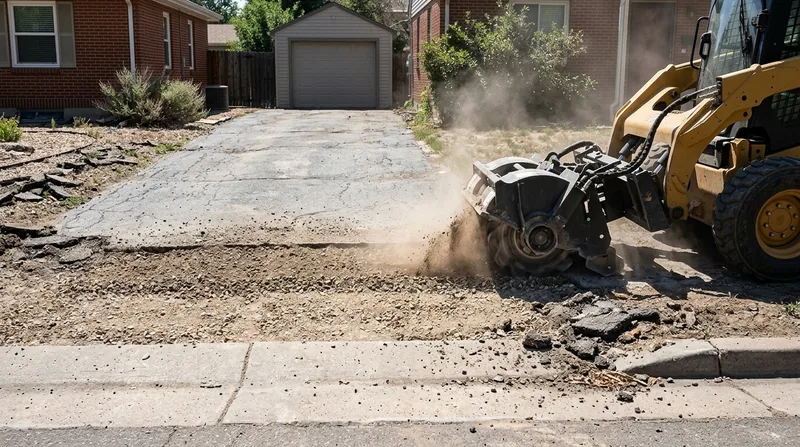




Asphalt Milling & Removal in Denver is the first step when an older driveway is too far gone for a patch but not quite ready for a full replacement. Denver's ranch-era and subdivision driveways from the 1980s through early 2000s sit on clay that swells and shrinks with every spring snowmelt and summer dry-down, and over two decades that movement cracks and oxidizes the surface layer until it turns brittle and grey. Milling grinds that worn asphalt down to a clean, compacted base so new hot mix can bond tight instead of riding on a layer that will fail again within a season. We remove the material, haul it to the recycler, and leave a smooth grade ready for overlay or new paving. It is a precision job that saves money compared to full-depth removal and keeps the foundation you already have working for you.
Why Milling Matters in Denver's Freeze-Thaw Climate
Denver sits at a mile elevation where the ground temperature swings wild between seasons. Spring snowmelt soaks into the clay beneath your driveway, and the clay swells. Summer heat and the dry Front Range air pull that moisture back out, and the clay shrinks. That cycle happens more than a hundred times a year, and asphalt on top of it cracks and heaves regardless of what the thermometer says. On top of that, Denver's ultraviolet load is roughly a quarter higher than sea-level pavement sees, so binder oxidizes and goes brittle faster than it should. After fifteen to twenty years, the surface layer is no longer bondable, and patching becomes a money pit.
- Milling removes the oxidized, cracked surface layer that no longer bonds to new asphalt.
- A clean, compacted subgrade gives new material a solid foundation instead of a slippery base.
- Milling costs less than full-depth removal because you keep the existing base and drainage.
- The milled material is recycled, so hauling and disposal costs drop compared to demo.
When the base underneath is still solid, milling and overlay is the smart repair path in Denver.
Key info: A driveway in Lakewood or Arvada that has been down for eighteen years and shows alligator cracking across thirty percent of the surface is a candidate for milling. If the base has heaved or the cracks run deep enough to see aggregate, a full-depth replacement may be necessary instead. We assess on site and tell you which path makes financial sense.
The City of Denver requires permits for driveway work that touches the apron where your drive meets the street, and utility locates are required by law before any grinding begins. Read more about driveway repair options to understand when milling fits versus other repair methods.
How We Mill and Prepare Your Driveway in Denver
Milling is a controlled grind. We call Colorado 811 for a utility locate so we know exactly where electric, gas, water and cable run, and we mark them on site. We set up the milling machine, which looks like a large grinder on wheels, and it slowly pulls across the surface grinding down to the depth you need. The machine collects the millings in a hopper, and we haul them to a recycling facility where they are crushed and reused in new asphalt or as a base material. Once the milling is done, we proof roll the base to make sure it is compacted and stable. Any soft spots get additional compaction or base repair. Then the surface is clean and ready for overlay or new paving.
- We call Colorado 811 before any work begins to locate utilities.
- The milling machine grinds to a depth we set based on the condition of your driveway.
- Millings are collected and hauled to a licensed recycling facility.
- We proof roll the base to verify compaction and find any soft areas.
- Any base repairs are done before we finish, so the grade is ready for paving.
The entire process usually takes one day for a residential driveway, depending on size and complexity.
Example: A 2,000-square-foot driveway in Denver that has been down for nineteen years and shows surface cracking and oxidation but no base heave is milled to a half-inch depth. We remove roughly 4 to 5 tons of material, haul it to the recycler, proof roll the base, and the grade is ready for a new half-inch overlay the next day. Total time on site is about six to eight hours.
See how milling fits into the broader asphalt resurfacing and overlay strategy to maximize the life of your investment.
| Milling Approach | Description | Best For |
|---|---|---|
| Partial-Depth Mill | Remove the top half-inch to one inch of surface asphalt, leaving the base intact. | Driveways with sound base and moderate oxidation or cracking that do not need structural repair. |
| Full-Depth Milling | Remove all asphalt layers down to the compacted subgrade, exposing the aggregate base. | Driveways where the base has failed, or where you need to add new base material before paving. |
| Mill and Overlay | Mill the surface and immediately lay new hot mix asphalt over the compacted grade. | The most cost-effective path when the base is solid and you need a refresh without full replacement. |
| Mill for Grading | Mill to adjust the slope or elevation of a driveway to improve drainage or fix low spots. | Driveways that puddle or have settled, where regrading is cheaper than full replacement. |
Asphalt Milling & Removal Cost in Denver: What to Expect
Milling typically runs from $1,500 to $3,500 for a residential driveway in Denver, depending on the size, depth of mill, and whether the base needs repair. A 2,000-square-foot driveway milled to a half-inch depth and hauled away costs less than one where we mill deeper or find soft spots that need subgrade work. Access also matters. A driveway with a tight turnaround or steep slope takes longer and costs more than one on a flat, open lot. If we find that the base is compromised during milling, additional base repair or replacement adds to the bill, but that is caught on site and discussed before we proceed.
The best way to know your actual cost is to get a written estimate that includes the depth of mill, the tonnage of material to be removed, and the condition of the base. We provide that on site with no obligation. We also recommend getting two or three estimates so you can compare scope, tonnage, and pricing across contractors. See our full pricing overview for context on how milling compares to other repair and paving options.
Asphalt Milling & Removal Near Me: What Denver Homeowners Should Know When Hiring
Hiring a contractor for milling is straightforward if you ask the right questions. First, verify that the contractor carries liability insurance and can show you a certificate. Second, get a written estimate that spells out the depth of mill, the tonnage of material, the base condition assessment, and the total price. Do not accept a verbal quote or a price per square foot without a site visit. Third, ask the contractor whether they have pulled or will help you navigate local permits. Denver requires permits for driveway apron work, and the contractor should know that. Fourth, ask about references from recent jobs in Denver. A local contractor with Denver plates and a Denver address is a stronger signal than a crew that travels from job to job.
- Ask to see proof of liability insurance and a certificate of coverage before you book.
- Request a written estimate that includes depth of mill, tonnage, and base assessment.
- Confirm that the contractor knows Denver's permit requirements for driveway apron work.
- Ask for references from driveway jobs completed in Denver or nearby in the past year.
- Verify that Colorado 811 utility locates will be called before any grinding begins.
If you have an HOA, check your architectural guidelines before you book. Some master-planned communities restrict driveway materials or require approval for resurfacing work. Contact us at (720) 674-7204 for a free estimate and we will walk you through the process and answer any questions about permits or HOA requirements in your neighborhood.
Asphalt Milling & Removal in Denver: Pricing Guide
| Service | Price | Details |
|---|---|---|
| Partial-Depth Mill (half-inch to one-inch removal) | Starting at $1,500 | Small residential driveway with sound base and moderate surface oxidation; cost rises with driveway size and access difficulty |
| Full-Depth Mill (remove all asphalt to subgrade) | Starting at $2,200 | Larger driveway or one where base repair is needed; tonnage and disposal cost are the main factors that move pricing up |
| Mill and Overlay (mill plus new hot mix asphalt) | Starting at $2,800 | Includes milling, base prep, proof roll, and new half-inch overlay; total cost depends on driveway size and overlay thickness |
| Base repair or regrading during milling | On estimate | Soft spots, low spots, or poor drainage found during milling require additional compaction or new base material |
| Travel and utility locates | Included | No separate mileage fee in Denver and surrounding areas; Colorado 811 utility locate is required and arranged by us |
| Free written estimate | No obligation | Response within 24 hours at (720) 674-7204; estimate includes depth, tonnage, base assessment, and total price |
Indicative pricing, the exact cost depends on square footage, finish, and site access. Free personalized estimate within 24h at (720) 674-7204.


