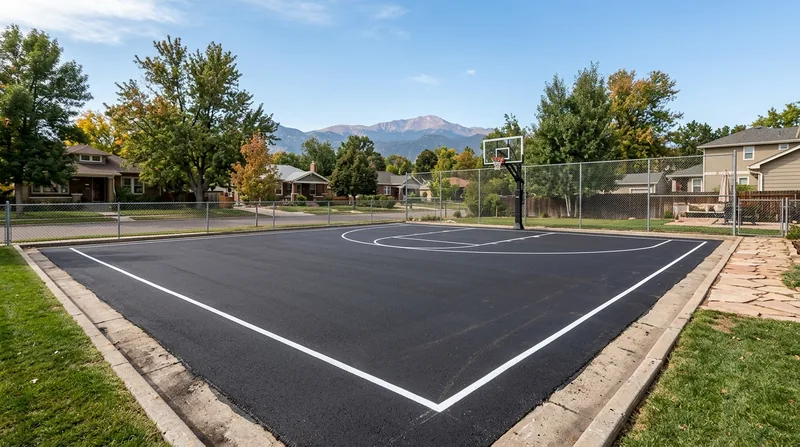




Sports Court & Path Paving in Denver means building a surface that survives the Front Range. Denver's high-altitude UV load and freeze-thaw cycles, more than a hundred crossings a year, age asphalt faster than at sea level, and mountain light greys out binder in years instead of decades. A basketball court or running path also takes impact loads and directional wear that a driveway does not. We build a smooth, durable surface pitched to drain, with a compacted base deep enough to handle the expansive clay underneath, so your court stays flat and playable through spring snow and hard summer sun.
Why Sports Court & Path Paving Matters in Denver's Climate
Denver sits at 5,280 feet where ultraviolet radiation is roughly 25 percent stronger than at sea level, and the ground beneath every court swells and shrinks with spring snowmelt and summer drought. Asphalt binder oxidizes faster under that light, and freeze-thaw cycles crack the surface if the base is shallow or the drainage is poor. A properly built sports court or path needs a thick compacted base, a smooth binder course, and proper pitch to shed water, all working together to stay flat and safe for play.
- Freeze-thaw cracking accelerates on surfaces without a deep, well-compacted aggregate base.
- High-altitude UV exposure degrades asphalt binder faster than at lower elevations, requiring a quality mix design.
- Poor drainage traps water in the base and accelerates failure during spring thaw cycles.
- Expansive clay soils under Denver courts move seasonally, so the base must be thick enough to flex without cracking the surface.
- Impact loads from basketball and tennis demand a smooth, stable surface that won't rut or develop low spots.
A well-designed court in Denver lasts 15 to 20 years with proper maintenance. Cutting the base depth or skipping proper drainage cuts that life in half.
Key info: Denver's municipal code requires permits for court construction and defines stormwater rules for impervious surfaces. Verify requirements with the Denver Community Planning and Development office before you start. HOA communities in Highlands Ranch, Centennial, and Littleton often have architectural standards for court materials and placement.
For more on how Denver's soil and climate affect paving decisions, see our guide to Asphalt Driveway Paving in Denver.
How We Build a Sports Court or Path in Denver
A sports court or path starts with the ground. We measure the site, check drainage and slope, then remove any failed asphalt or soft soil. We bring in compacted crushed stone or recycled asphalt base, typically 4 to 6 inches deep, and proof-roll it to ensure it will not settle. Then we lay a binder course and a smooth surface course, both pitched slightly to drain water away from the court. The surface is finished smooth and level so a ball rolls true and players do not twist an ankle on a rut or low spot.
- We locate utilities with Colorado 811 before any excavation begins.
- We remove and haul away failed asphalt or soft subgrade material.
- We install a 4 to 6 inch compacted base of crushed stone or recycled asphalt.
- We proof-roll the base to verify it will support the surface without settling.
- We lay a binder course and finish with a smooth surface course, pitched to drain.
- We compact the asphalt to the density required for durability and flatness.
The entire process takes 2 to 5 days depending on court size and weather. New asphalt must cure for 6 to 12 months before it is sealed, and during that time the binder continues to harden.
Example: A residential basketball court in Arvada, 30 feet by 50 feet, typically requires 3 to 4 inches of base, a binder course, and a surface course. A running path in Westminster, 8 feet wide and 200 feet long, is built the same way but with less total tonnage. Both are pitched at 1 to 2 percent so water runs off and does not pool.
Learn more about resurfacing and overlay if an existing court needs repair instead of a full rebuild.
| Approach | Description | Best for |
|---|---|---|
| Full-Depth Court Build | Remove old asphalt, install 4 to 6 inch compacted base, lay binder and surface courses, finish smooth and pitched. | New courts on bare ground or where old surface has failed or is too soft. |
| Overlay on Existing Base | Mill or clean the existing surface, install new binder and surface courses, re-pitch to drain. | Courts with a sound base but a worn or cracked surface that is still structurally solid. |
| Path or Lane Paving | Graded subgrade, 3 to 4 inch compacted base, binder and surface courses, smooth finish with gentle slope. | Running paths, walking trails, and access lanes where traffic is light to moderate. |
| Recycled Asphalt Base Option | Use reclaimed asphalt millings as the base layer, compacted and proof-rolled, then new binder and surface. | Budget-conscious projects where the subgrade is stable and the base does not need to be virgin stone. |
Sports Court & Path Paving Cost in Denver: What to Expect
A residential basketball or tennis court in Denver runs from $8,500 to $15,000 for a 30-by-50-foot surface, depending on site preparation, base depth, and local soil conditions. A running path or walking trail costs less per square foot because it is narrower and does not require the same level of precision flatness. The biggest cost drivers are the depth and type of base you need, whether utilities or structures nearby limit access, and whether the existing ground is stable or requires extra fill and compaction.
Denver's expansive clay soils often mean you need a thicker or more robust base than you would at sea level, so estimates vary. We always measure on site and provide a written estimate with tonnage and thickness specs before we start, so you know exactly what you are paying for. For detailed pricing on similar services, see our pricing page.
A court built today will need routine maintenance (sweeping, minor patching) to stay in good shape. Avoid sealcoating for the first 6 to 12 months while the asphalt cures. After that, periodic seal coat applications every 2 to 3 years extend the life of the surface and protect it from UV and water damage.
Sports Court & Path Paving Near Me: What Denver Homeowners Should Know
Hiring a paving contractor for a sports court is different from hiring for a driveway. A court needs to be flat, properly pitched, and built on a strong base, and mistakes are expensive to fix. Get 2 to 3 written estimates from local contractors, not national franchises or itinerant crews. A solid estimate includes a site visit, measurements, base depth and type, tonnage, course thicknesses, and a timeline. Avoid any contractor who quotes over the phone or wants a large cash deposit before work begins.
Ask whether your city requires a permit for court construction. Denver does, and the permit process includes a site inspection and compliance with stormwater rules. If you are in an HOA community in Highlands Ranch, Littleton, or Centennial, check architectural guidelines before you start. We help homeowners navigate local permitting and coordinate with the city, but the rules and final approval are always yours to verify.
Check references from past court or path jobs, not just driveways. Ask how long the surface has held up and whether the contractor stood behind the work if cracks or drainage problems appeared. A paving contractor should be fully insured and willing to provide proof of coverage. For a free estimate and honest advice on your court or path, contact us at (720) 674-7204.
Sports Court & Path Paving in Denver: Pricing Guide
| Service | Price | Details |
|---|---|---|
| Residential Basketball or Tennis Court | Starting at $8,500 | 30 by 50 feet, full-depth build with compacted base, binder and surface courses, smooth finish and proper pitch. |
| Running Path or Walking Trail | Starting at $5,500 | 8 feet wide, 200 feet long, 3 to 4 inch base, binder and surface, sloped to drain. Narrower than a court, lower total tonnage. |
| Overlay on Existing Sound Base | Starting at $4,200 | Existing court with worn surface but solid base. Mill or clean surface, install new binder and finish course, re-pitch. |
| Site Prep, Grading, and Utilities Locate | Included in estimate | Colorado 811 utility locate, grading and base prep, proof-rolling. Cost varies by site condition, included in total quote. |
| Travel and Free Estimate | Included in Denver area | No mileage fee or travel charge in Denver and surrounding areas. Free estimate within 24 hours, call (720) 674-7204. |
Indicative pricing, the exact cost depends on square footage, finish, and site access. Free personalized estimate within 24h at (720) 674-7204.


