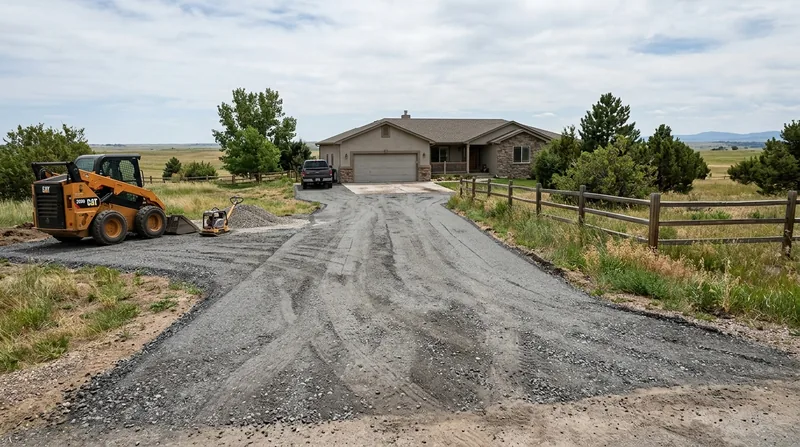




Recycled asphalt and millings driveways give Denver homeowners a lower-cost surface option that still stands up to the expansive clay movement underneath most Front Range properties. Unlike fresh hot mix asphalt, recycled millings compress and bond over time, and because they cost roughly half what new asphalt does, they make sense for rural driveways, long farm lanes, and budget-conscious repairs across Jefferson, Arapahoe, and Douglas counties. The catch is preparation: we grade and compact the base first, because skipped compaction is what usually makes a Denver driveway fail early, whether the surface is new asphalt or recycled stone. The ground underneath moves with the seasons here, and a solid base absorbs that movement instead of letting it crack through the top layer.
Why Recycled Asphalt & Millings Matter in Denver's Driveway Market
Denver's older neighborhoods and the post-war ranch sprawl through Lakewood, Arvada, and Aurora sit on driveways poured decades ago, and thousands of original surfaces from the 1990s and 2000s are aging out together. Replacements are expensive. Recycled millings offer a real alternative for properties where the base is sound but the top surface has weathered, or where budget constraints make a full new asphalt installation unrealistic. The material compacts hard under Denver's dry climate and the freeze-thaw cycle that runs a hundred crossings a year. Millings also shed water better than loose gravel because the binder in the recycled stone re-bonds in the heat, creating a semi-solid surface that doesn't dust or track mud the way raw crushed rock does.
- Recycled millings cost roughly 50 percent less than new hot mix asphalt, making them ideal for long rural driveways or budget repairs.
- The material re-hardens under Denver's sun and compaction, creating a bound surface that resists rutting and dust better than gravel.
- Proper base preparation (grading and compaction) is the single factor that determines whether millings hold or fail within a year.
- Millings work best on driveways with gentle slopes and good drainage, because standing water breaks down the binder.
- A recycled asphalt surface typically lasts four to seven years in the Denver climate before weathering requires re-application or upgrade to new asphalt.
Getting the base right is what separates a driveway that holds from one that washboards and ruts. We start with grading and proof rolling to identify soft spots, then compact the aggregate base to the density the clay underneath can handle.
Local example: A rural property south of Castle Rock with a quarter-mile lane and no municipal paving requirement got recycled millings over a properly compacted base for roughly $2,800. A new asphalt surface would have run $7,500 plus. The millings held through two winters and are now due for re-application, which costs a fraction of what a full replacement would.
For more details on how base preparation protects any driveway surface, see our guide to gravel driveway installation and grading.
How We Install Recycled Asphalt & Millings Driveways in Denver
The installation process for recycled millings is straightforward, but the results depend entirely on what happens below the surface. We start by inspecting the existing base and the drainage pattern, then grade the driveway to a two to three percent slope so water runs off instead of pooling. After grading, we place the compacted aggregate base (usually four to six inches of crushed stone) and proof roll it to ensure it won't settle unevenly under the weight of vehicles. Only then do we apply the recycled millings, typically three to four inches, and compact them with a vibratory roller until they bond together and darken.
- We inspect the existing base and drainage to identify soft spots or poor grading that would undermine the new surface.
- We grade the driveway to shed water (typically two to three percent slope) so millings don't sit in standing water.
- We place and compact a four to six inch aggregate base, then proof roll it to catch settling before the top layer goes down.
- We apply recycled millings in a three to four inch lift and compact with a vibratory roller until the binder re-hardens and the surface darkens.
- We verify compaction density and crown to ensure water sheds and the surface won't rut under typical vehicle loads.
The entire process typically takes two to three days for a standard residential driveway, depending on the existing condition and whether we need to remove old asphalt first.
Denver example: A Littleton property with a failing asphalt driveway and tight budget chose recycled millings over full driveway replacement. We removed the old asphalt, graded and compacted a new base, then applied millings. The homeowner saved roughly $4,000 compared to new asphalt and got a usable surface that will last four to five years before re-application or upgrade.
Recycled Asphalt & Millings vs. Other Driveway Surfaces
| Surface Type | Cost (per sq ft) | Lifespan in Denver | Best For |
|---|---|---|---|
| Recycled Asphalt Millings | $1.50 to $2.50 | 4 to 7 years | Rural driveways, budget repairs, temporary surfaces |
| Raw Gravel or Crushed Stone | $0.75 to $1.25 | 1 to 3 years | Temporary access, farm lanes, low-traffic areas |
| New Hot Mix Asphalt | $3.00 to $5.00 | 12 to 20 years | Residential driveways, parking lots, high-traffic areas |
| Tar and Chip | $1.50 to $2.75 | 5 to 10 years | Rural driveways, aesthetic preference, moderate budgets |
Recycled millings occupy the middle ground between raw gravel and new asphalt. They cost significantly less than new asphalt but offer better durability and appearance than loose stone. The trade-off is that they require a solid base and regular attention to drainage, and they will not last as long as new asphalt in the Denver climate.
Recycled Asphalt & Millings Driveways Cost in Denver: What to Expect
Recycled asphalt millings driveways in Denver start at roughly $1.50 to $2.50 per square foot for material and labor, which means a standard 500-square-foot driveway runs between $750 and $1,250. That is significantly less than new asphalt (typically $3.00 to $5.00 per square foot), but the real cost driver is what happens below the surface. Base preparation, grading, and compaction can add $500 to $2,000 depending on the existing condition, the slope, and whether old asphalt needs removal. A driveway with a poor base or severe grading issues will cost more to prepare than one with solid ground underneath.
Several factors move the final price up or down. Long rural driveways cost less per square foot than short urban ones because setup and equipment time is spread across more area. Driveways with existing asphalt that needs removal add labor and disposal costs. Properties with poor drainage or soft clay require deeper base preparation. And proximity to structures or utilities may require additional care during grading. We provide written estimates with tonnage specifications and a detailed breakdown of materials and labor, so you know exactly what the work includes before we start.
For a complete pricing overview across all our services, visit our pricing page. Getting two or three estimates from local contractors is always smart, because the quality of base preparation and the contractor's understanding of Denver's clay and freeze-thaw cycle will vary. The lowest bid is often the one that skips the compaction step, and that is precisely where Denver driveways fail.
Recycled Asphalt & Millings Driveways Near Me: What Denver Homeowners Should Know When Hiring
Choosing a paving contractor for recycled millings or any asphalt work in Denver requires the same diligence you would apply to any major home improvement. Start by verifying that the contractor is fully insured, and ask to see the certificate of insurance. In Denver, paving contractors may be subject to municipal licensing and permitting requirements, depending on whether the work involves the street right-of-way or curb cut. Always check with your local building department before you book, especially if your driveway apron meets the public street or if your property is in an HOA with architectural standards. A reputable contractor will help you navigate local permitting, not promise to handle it and then leave you with a bill from the city.
Get written estimates from at least two contractors, and make sure each one specifies the depth of base preparation, the tonnage of recycled millings, and the compaction method. Estimates without those details are incomplete. Ask for references from similar jobs (rural driveways or millings installations, not just new asphalt), and follow up with at least one. Call the Colorado 811 utility locating service before any digging happens, because hitting a buried gas, electric, or water line is a serious and costly mistake. Avoid any contractor who offers cash discounts, requires a large deposit upfront, has out-of-state plates, or solicits you unsolicited at the door. Those are the classic markers of paving fraud.
We have been in business in Denver since 2012, and we work under local conditions every day. Our estimates include written specifications and tonnage, and we can answer questions about Denver's clay, the freeze-thaw cycle, and why base preparation matters more than surface choice. For a free estimate, call us at (720) 674-7204 or contact us online. We respond within 24 hours, and there is no obligation to book.
Recycled Asphalt & Millings Driveways in Denver: Pricing Guide
| Service | Price | Details |
|---|---|---|
| Recycled Asphalt Millings (material and labor) | Starting at $1.50 to $2.50 per sq ft | Includes grading, base compaction, millings application, and vibratory rolling for a bound surface |
| Base preparation and grading | Additional $500 to $2,000 | Depends on existing condition, slope correction, old asphalt removal, and compaction depth required |
| Drainage and slope correction | Included in base prep | Proper grading to shed water is essential for millings durability and prevents standing water failure |
| Removal of old asphalt | $0.50 to $1.00 per sq ft | Milling or removal of failed surface before new base and millings are laid |
| Travel and site visit | Included | No separate mileage charge for Denver and surrounding service areas |
| Free written estimate | No charge | Includes tonnage specs, base depth, and labor breakdown, response within 24 hours |
Indicative pricing, the exact cost depends on square footage, finish, and site access. Free personalized estimate within 24h at (720) 674-7204.


