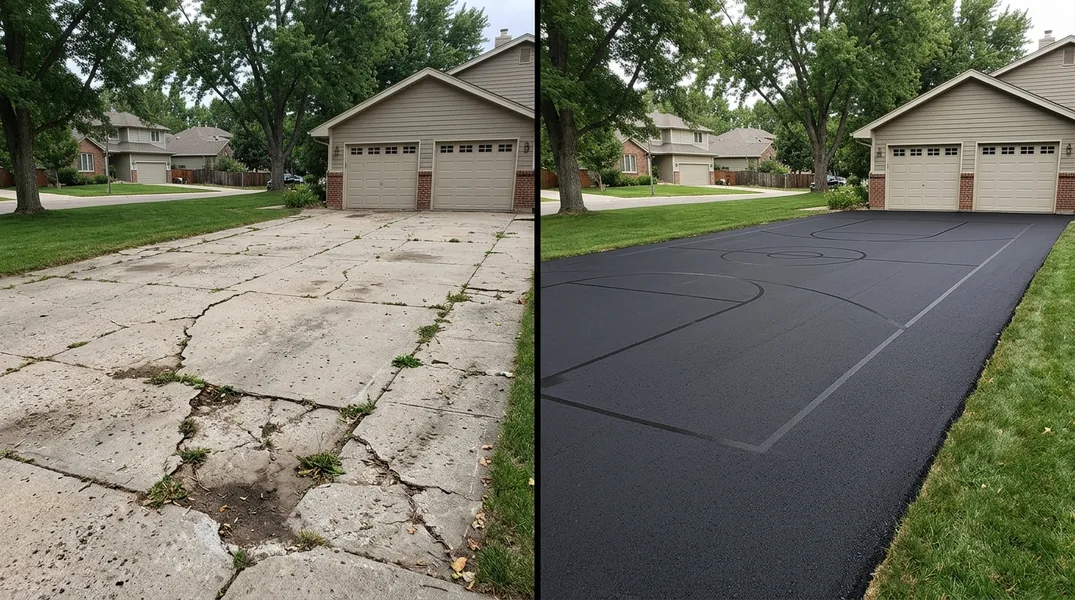
The 1990s Driveway Crisis in Douglas and Weld Counties
If you own a home in Douglas or Weld Counties with an asphalt driveway installed in the 1990s, you're likely noticing significant deterioration. After three decades of exposure to Colorado's harsh climate, freeze-thaw cycles, intense UV radiation, and heavy vehicle traffic, these driveways have finally reached the end of their serviceable life. What once was a smooth, dark surface is now riddled with cracks, potholes, and crumbling edges. This isn't a coincidence or a sign of poor initial installation. It's simply the natural lifecycle of asphalt reaching its inevitable conclusion.
The 1990s were a different era for driveway construction standards. Many contractors used materials and techniques that were acceptable at the time but would be considered substandard by today's engineering practices. Combined with the relentless Colorado weather, these aging driveways are now failing at an accelerated rate. Homeowners across the region are facing difficult decisions: do they invest in a full replacement, or are there more affordable interim solutions available? Understanding why these driveways are failing now is the first step toward making an informed decision about your property.
Understanding Asphalt Degradation Over 30+ Years
Asphalt is not a permanent material. It's a blend of bitumen (a sticky petroleum byproduct) and aggregate (crushed stone and sand) that hardens when laid and cooled. Over time, the bitumen oxidizes when exposed to sunlight and oxygen, losing its flexibility and binding strength. In Denver and surrounding areas, this degradation accelerates due to our high altitude, intense sun exposure, and dramatic temperature swings. Winter freezing causes water to penetrate micro-cracks, expand, and force the asphalt apart. Summer heat then softens the remaining bitumen, allowing further deterioration.
Driveways installed in the 1990s have now experienced roughly 30 freeze-thaw cycles per year for three decades. That's nearly 900 cycles of expansion and contraction. Each cycle weakens the asphalt's structural integrity slightly. Add to this the weight of vehicles, the impact of snowplows, and the abrasive effect of road salt and sand, and you have a recipe for systematic failure. The asphalt doesn't fail suddenly. It fails progressively, starting with hairline cracks that widen into alligator cracking, then progressing to potholes and complete surface breakdown.
Why Your Driveway is Failing Now: The Perfect Storm
Several factors converge to explain why so many 1990s driveways are failing simultaneously across Douglas and Weld Counties. First, asphalt has a realistic design life of 15 to 20 years under normal conditions, or up to 30 years with excellent maintenance and favorable climate. Your driveway is now well beyond that window. Second, most homeowners don't perform regular maintenance such as seal coating, crack filling, or timely repairs. Without these preventive measures, the degradation process accelerates dramatically. A driveway that receives annual seal coating might last 25 to 30 years. One that's neglected might fail in 15 to 20 years.
Third, the cumulative effect of deferred maintenance cannot be overstated. Small cracks that should have been sealed 10 years ago are now foot-wide sections of missing asphalt. Drainage issues that could have been corrected early on have now caused base layer failure and subsurface erosion. By the time most homeowners realize their driveway needs attention, the damage extends far deeper than the surface layer. This is why Driveway Repair becomes increasingly expensive as the problem worsens. What might have cost $500 in targeted repairs five years ago now requires thousands of dollars in comprehensive solutions.
Recycled Asphalt Millings Driveway: A Budget-Friendly Alternative
If a complete Asphalt Driveway Paving & Installation seems out of reach financially, recycled asphalt millings offer an interesting interim solution. Asphalt millings, also called recycled asphalt or crushed asphalt, are reclaimed asphalt pavement (RAP) from old driveways, parking lots, and road surfaces. These fragments are cleaned, sorted, and sold as a material for driveway resurfacing or repair. The key advantage is cost. A millings driveway costs significantly less than new asphalt installation, making it an attractive option for budget-conscious homeowners.
However, homeowners should understand the limitations of this approach. While asphalt millings driveway solutions can extend the life of a severely deteriorated surface by 3 to 5 years, they are not a permanent fix. The millings compact over time and are more susceptible to washout during heavy rain. They also require annual raking and compaction to maintain a smooth surface. A crushed asphalt driveway works best as a temporary measure while you save for a full replacement or as a cost-effective solution for secondary driveways or parking areas. For your primary residence driveway in Denver, a more durable option is usually worth the investment.
Asphalt Millings Driveway Cost in Denver: What to Budget
The millings driveway cost typically ranges from $0.50 to $1.50 per square foot for material and basic installation, compared to $3 to $8 per square foot for new asphalt. For a standard 500-square-foot driveway, recycled asphalt millings might cost $250 to $750, while new asphalt would cost $1,500 to $4,000. This dramatic difference explains why many homeowners consider millings as a stopgap solution. However, you must factor in ongoing maintenance costs. Annual raking, compaction, and top-up applications of fresh millings can add $100 to $300 per year to your maintenance budget.
When evaluating asphalt millings driveway pricing, it's important to consider the total cost of ownership over time. If you apply millings today for $500, then spend $200 annually for three years on maintenance, you've invested $1,100 total. At that point, the surface may still require replacement. A new asphalt driveway, while more expensive upfront, typically requires minimal maintenance for the first 5 to 7 years and lasts 20 to 30 years total. For most homeowners, the long-term value of new asphalt outweighs the short-term savings of recycled asphalt millings.
When to Call a Professional: Your Options for 1990s Driveway Repair
If your 1990s driveway is showing significant signs of failure, you have three main options. First, you can apply temporary fixes like asphalt millings or seal coating to extend its life another few years while you save for replacement. Second, you can invest in Asphalt Resurfacing & Overlay, which involves applying a new 1.5 to 2-inch layer of asphalt over the existing surface. This costs $2 to $5 per square foot and can add 15 to 20 years of life to your driveway. Third, you can opt for complete replacement with new asphalt, which provides the longest lifespan and best appearance but requires the highest upfront investment.
The best choice depends on your budget, timeline, and how much longer you plan to own the property. If you're selling within the next few years, a cosmetic solution might suffice. If you're staying long-term, replacement or resurfacing makes more financial sense. Denver Asphalt Paving specializes in all three approaches and can evaluate your specific driveway to recommend the most cost-effective solution. Call (720) 674-7204 today or request a free estimate to discuss your options with a professional contractor who understands the unique challenges of aging asphalt in Colorado's climate.
Looking for a professional asphalt paving contractor in Denver? Denver Asphalt Paving responds fast for all your asphalt paving needs.
Get a Free Quote